


- 德国HYDRO-BIOS公司
- 丹麦KC-Denmark公司
- 德国SubCtech公司
- 法国HYDROPTIC公司
- 青岛道万科技有限公司
- 丹麦MicroWISE公司
- 冰岛Star Oddi公司
- 德国AMT公司
- 英国RS AquaE公司
- 英国Valeport公司
- 英国C-MAX公司
- 英国Impact Subsea公司
- 加拿大AML公司
- 加拿大Pro-Oceanus公司
- 加拿大Metocean公司
- 加拿大RBR公司
- 挪威Aanderaa公司
- 芬兰Vaisala公司
- 美国Apogee公司
- 美国Licor公司
- 美国JW Fishers公司
- 美国Seapoint公司
- 美国Kovacs公司
- 美国SeaView System公司
- 美国SONOTRONICS公司
- 美国Turner Designs公司
- 美国SofarOcean公司
- 美国PST公司
- 青岛水德科技有限公司
-
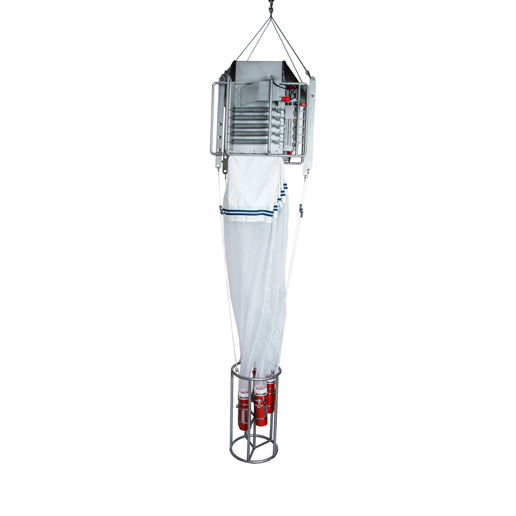 HYDRO-BIOS: Multiple Plankton Sampler
Smart Sampling at its best – with the improved MultiNet generation of the Multiple Plankton Sampler, the world’s leading sampling system for horizontal, oblique and vertical collections in successive water layers. The MultiNet can be delivered in 4 sizes (apertures): Mini (0.125 m²), Midi (0.25 m²), Maxi (0.5 m²) and Mammoth (1 m²). Depending on the model 5 or 9 net bags are attached to the stainless steel frame with strong canvas part by means of zip fasteners. The net bags are opened and closed by means of levers which are triggered by a battery powered Motor Unit. The commands for actuation of the net bags are given via single or multi-conductor cable between the Underwater Unit and the included Deck Command Unit. A wide selection of mesh sizes for the net bags is available to meet the requirements of all standard and non-standard applications. For common horizontal collections a mesh size of 300 microns is recommended (mesh sizes from 100 to 780 microns available), for vertical collections mesh sizes from 55 to 780 microns are applicable. For mesh sizes below 100 microns it is recommended to use an enhanced net bag (for example a double-layered net bag: one with 55 microns plus one with 300 microns ).
-
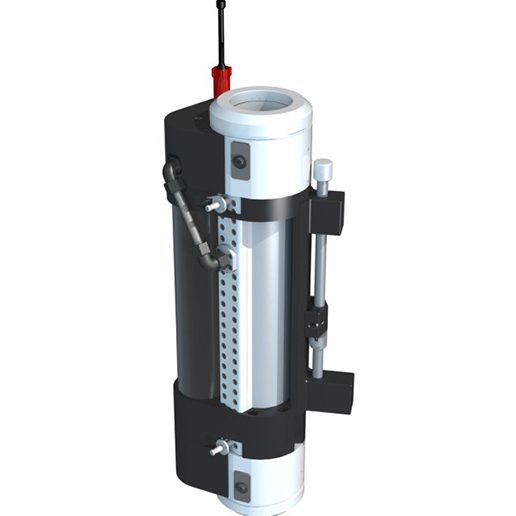 HYDRO-BIOS: Automatic Fluid Injection Sampler AFIS
The Automatic Fluid Injection Sampler AFIS provides a novel technique to enhance sampling technology for studying microbially driven biogeochemical processes in the environment by the analysis of metatranscriptomes (messenger RNA).
Transcripts degrade fast – within seconds to minutes. It is known that their abundance patterns detected in nature are subject to considerable modification not only due to environmental changes but simply as a result of sampling procedures. Traditional sampling from a ship using conventional water sampling bottles usually takes many minutes to some hours, providing plenty of time for modification.
To overcome this problem, AFIS takes samples and rapidly fixes water directly in the original environment and thereby instantaneously conserves the gene expression profile in situ. This allows a reliable evaluation of microbially driven processes based on metatranscriptomics.
Additional applications are expected in the field of conventional water sampling where immediate fixation of biological matters or chemical substances inside the sample is needed.
The single-bottle version AFISsingle has been designed to be operated inside common rosette water sampling systems or as stand-alone instrument when mounted to hydrographic wires or other subaqueous structures like landers, ROVS etc.
-
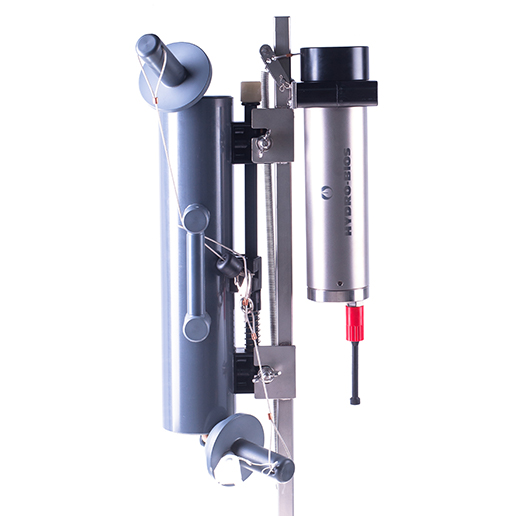 HYDRO-BIOS: Single Fire Module
The time-tested Multi Water Sampler technology reduced to the max – releasing a single water sampler at a precise depth.
The Single Fire Module consists of a Plastic Water Sampler (also known as Niskin Bottle) of 1.7 litres capacity, mounted to a stainless steel rack which is equipped with a motor-driven release device. Power supply is made by internal rechargeable lithium-ion batteries, using the safest chemistry currently available.
-
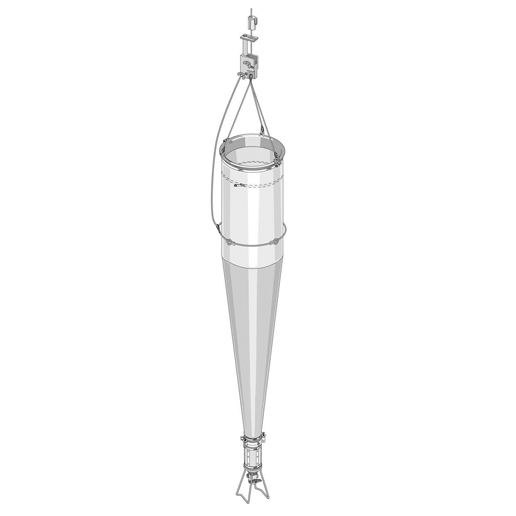 HYDRO-BIOS: WP2 Closing Net
Based on the design of the UNESCO Working Party 2, the WP2 Closing Net is a vertical plankton net with messenger operated closing mechanism. A 57 cm diameter stainless steel ring with a 2.6 meter long net bag (default 200µm, or as per choice) is operated in conjunction with a heavy net bucket frame for high towing rope speed during descent.
For easy retrieval the sample is concentrated inside a removable plastic net bucket with side window (covered with sieve gauze). The open net is brought to the greatest scheduled depth. During ascent the net can be closed in the intended depth by strangulating the net bag below the net ring. This allows for sampling defined depth layers.
The WP2 Closing Net can be used in conjunction with one Mechanical Flow Meter with back-run stop for measurements of filtered water volume.
-
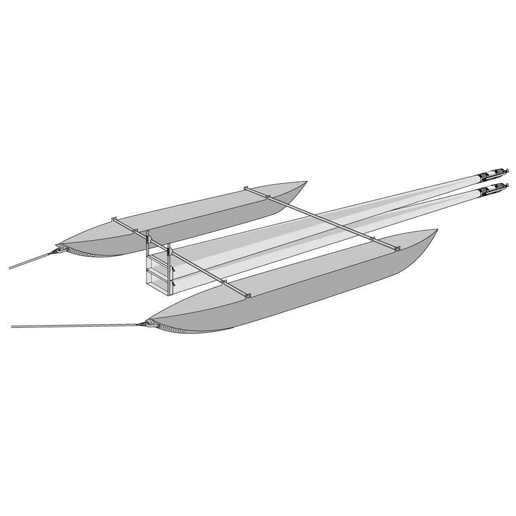 HYDRO-BIOS: Neuston Net acc. to David/Hempel Model 300
The Neuston Net acc. to David/Hempel Model 300 has been designed for accurate epineuston and hyponeuston sampling. A current field of application is e.g. microplastic sampling. It consists of a slender catamaran swimmer body of aluminium with relative high draft, caring for a stable position even under choppy conditions at sea. The vertically adjustable double net frame receives the rectangular surface and sub-surface net bags with a standard mesh size of 300 µm (or as per choice between 100 and 500 µm).
For easy retrieval the sample is concentrated inside two removable plastic net buckets with side window (covered with sieve gauze). A bridle with one adjustable leg is used to operate the net from starboard, portside or stern.
-
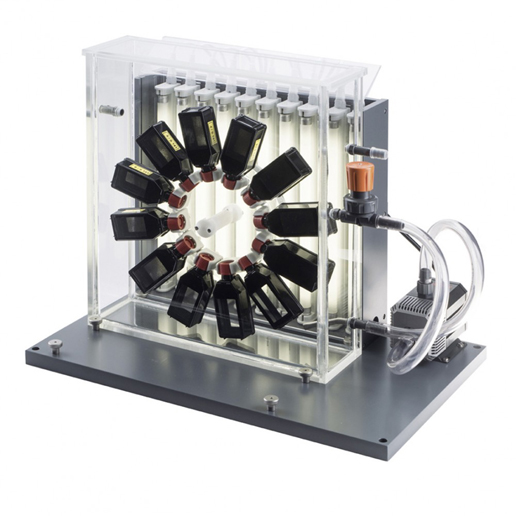 HYDRO-BIOS: ICES Incubator
The ICES Incubator consists of an illuminated transparent plexiglass tank incorporating a turning wheel on which 12 experimental bottles can be clamped. The tank is filled with water which is set in motion by an adjustable circulating pump. Thus the turning wheel is set in rotation at speeds up to 10 rpm with the experimental bottles acting as paddles. Tank connections for a second water circulation allow for temperature adjustments of the water by using external tempering equipment.
The 12 experimental bottles of 50 ml capacity each have different optical coatings, so that each bottle has individual transmission rates and thus generating a number of 12 different irradiance (or light intensity) levels.
The illumination unit is equipped with 10 fluorescent tubes with a wave spectrum according to ICES specifications, each can be switched individually. For higher irradiance levels a second illumination unit can be mounted onto the ground plate of the ICES Incubator.
-
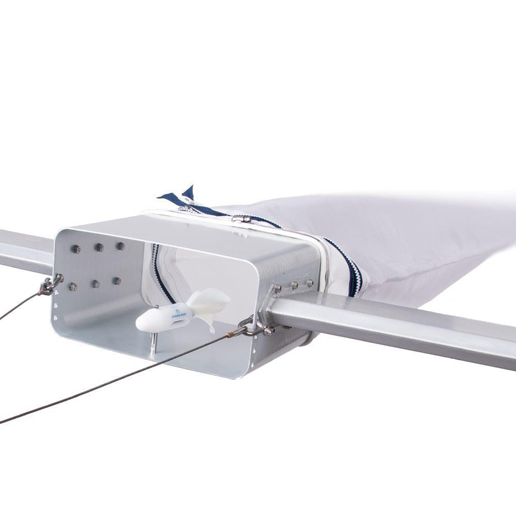 HYDRO-BIOS: ‘Manta’ for Microplastics
The Microplastic Net ‘Manta’ has been designed for open but calm waters, rivers, lakes. The speciality of the Manta design is that it has ‘wings’ mounted to the sides that lift the frame up and care for stability. For transportationor storage these can easily be unscrewed. The net opening is 15 x 30 cm and has one special feature. There is a little pin inside to which a Mechanical Flow Meter can be mounted. The maximum speed is rated to 3 knots.
-
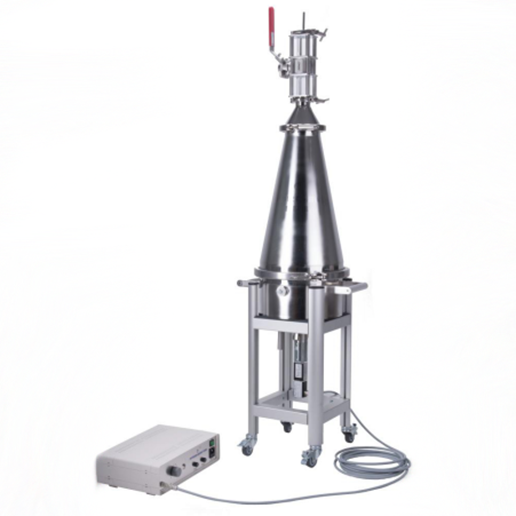 HYDRO-BIOS: MicroPlastic Sediment Separator MPSS
Although plastic debris is constantly accumulating in aquatic environments, its impact is not yet fully understood. The establishment of a reliable, verified and standardised method to quantify the amount of plastic particles in the environment plays a key role to assess the consequences of plastic debris in aquatic ecosystems.
We significantly improved the classic density separation approach by launching the MicroPlastic Sediment Separator MPSS. It enables a reliable separation of different ecologically relevant size classes of plastic particles from sediment samples. A ZnCl2-solution (1.6-1.7 kg/L) or SODIUM POLYTUNGSTATE (non-toxic alternative) as separation fluid allows for an extraction of plastic particles ranging from large fragments to small microplastic particles (S-MPP, < 1 mm). Subsequent identification and quantification of the particles with a spatial resolution down to 1 μm can be performed using Raman Microspectroscopy.

Official WeChat

Official Website